
Yorktown Previous Residents by Era
A previous residents trail for a Yorktown address has a long official path, but every source answers a different part of the question. Use Yorktown land records to follow title, maps to compare old Yorktown lot geography, household sources to test whether a person was connected to the place, and Yorktown estate files to explain a transfer. The current Yorktown street number is only a starting label. The most reliable handoff is the Yorktown parcel’s section, block, and lot, often called SBL, plus the deed’s legal description.
| Historical source | Documented period | Where held | What it contributes |
|---|---|---|---|
| Westchester Records Online gateway | It advertises 18th-century deeds through recent County Clerk material | County Clerk online account gateway | Yorktown title-search route; detailed online cutoffs were not verified. |
| Grantor/grantee index | 1680–1907 | Westchester County Archives | Early owner-to-owner transfer trail. |
| Mortgage index | 1680–1897 | Westchester County Archives | Financing and name chronology. |
| Estate records and maps | 1782–1909; maps c.1766–present | Westchester County Archives | Heirs, executors, lot geography, and road continuity. |
| Hart obituary index | October 1966–December 2007 | John C. Hart Memorial Library | Death and family leads; missing issues are excluded. |
| Federal census | 1790–1950 released | NARA, Census, and research access points | A dated Yorktown household and place snapshot, with varying address detail. |
For recent Yorktown ownership, begin with the Yorktown Assessor and the Westchester County Municipal Tax Parcel Viewer. For a much older Yorktown question, use the Archives rather than claiming a screen has all of the historical chain. No verified Yorktown-wide criss-cross or published city-directory run supports a promise that every former occupant will be found by address.
Start Yorktown House History With SBL
The County viewer first asks the user to choose Yorktown, then supports address, print-key, and owner-name searching where municipal data is available. The displayed Yorktown parcel and its print key help translate a street address into an identifier the Town can use. Yorktown’s Assessor accepts requests for property record cards, ownership or sale confirmation, tax-map splits or merges, and abutter lists. The Town of Yorktown FOIL form expressly asks for section, block, and lot for property research.
The key distinction is situs versus mailing address. A situs is the physical Yorktown parcel location. A mailing address is an administrative contact and can belong to an agent, post-office box, entity, or owner who lives elsewhere. For previous Yorktown residents, record it as an address field only. It neither proves the owner lived there nor identifies renters or other household members.
- SBL
- Section, block, and lot, Yorktown’s tax-map identifier for a property.
- Situs address
- The physical location of the parcel.
- Legal description
- The lot, subdivision, or boundary wording used in a recorded land document.
- Chain of title
- The sequence of ownership transactions supported by recorded instruments.
Note: Keep the current Yorktown street address, the Yorktown SBL, the postal hamlet and ZIP, and the legal-description wording together before searching older records.
Yorktown Deed Chain Backward
The Westchester County Clerk’s Westchester Records Online gateway advertises Land Records, Legal Records, Maps, and Trades paths. Its public landing screen does not expose the authenticated advanced land fields, so do not assume a particular online filter or image cutoff. Use the gateway or Land Records counter to locate a relevant Yorktown recorded instrument, then preserve the grantor, grantee, recording reference, document type, and legal description.
- Find the current Yorktown parcel and request Assessor ownership or sale confirmation when needed.
- Locate a deed in which the current Yorktown owner is the grantee, the buyer receiving title.
- Read the seller, the grantor, then search that former owner as a grantee for the prior acquisition.
- At each handoff, compare legal description, lot or subdivision reference, and SBL instead of relying only on the current Yorktown street wording.
- Move to the County Archives for older indexes, maps, or paid research when the electronic path no longer provides the needed reference.
A grantor transfers an interest; a grantee receives it. A Yorktown deed chain can establish ownership transitions, trusts, estate transfers, or entity transactions. It cannot show everyone who lived in the house, the date a household moved, or a personal relationship among people with the same surname.
Westchester’s Deep Yorktown Record Ladder
Yorktown has an unusually long county record ladder. The Westchester County Archives research service lists grantor/grantee indexes from 1680–1907, mortgage indexes from 1680–1897, estate records from 1782–1909, and maps from about 1766 to the present. When an old Yorktown deed lacks the modern address, compare the legal description, filed map, neighboring lots, and historical map before deciding it is the same place.
The Archives can retrieve an identified Yorktown record for a Yorktown property for $15 or perform custom Yorktown research at $25 per hour. Its stated first ten pages are included, with extra copies at 50 cents per page. Mail research is a real fallback when an index points to a book or image that is not available remotely. It is not a shortcut around uncertain matches, and it does not hold every vital record.
Yorktown Maps When Addresses Change
Yorktown is a town with five documented postal identities, not one compact postal label. Amawalk uses 10501, Jefferson Valley 10535, Mohegan Lake 10547, Shrub Oak 10588, and Yorktown Heights 10598. An older Yorktown clipping, probate file, or library catalog may use one of those names. Re-run a place search with the historic postal community and compare it to the SBL or lot reference before treating a failed modern-address search as proof that the property was absent.
The County viewer for Yorktown has boundaries that are approximate and not a survey. Its layers can show zoning, wetlands, flood plains, school or fire districts, and utilities, which explain the Yorktown parcel’s setting but not who lived there. A historic Yorktown map can resolve road or lot continuity, while a building, planning, or permit file can date construction work. Those files document projects, applicants, or sites, not a complete succession of residents.
Yorktown Previous Residents in Local Sources
Yorktown ownership is only one part of a previous-residents trail. John C. Hart Memorial Library’s Local History collection has more than 200 local-history books, six indexed Yorktown History Scrapbooks, online newspaper links, on-site Ancestry Library Edition, and a searchable Yorktown Obituary Index for the North County News. That index covers October 1966 through December 2007, with missing issues excluded. It is a lead to the underlying clipping, not proof that an indexed name lived at one address.
The Hart Library local-history page shows the Yorktown resource used for obituary, scrapbook, and genealogy leads.
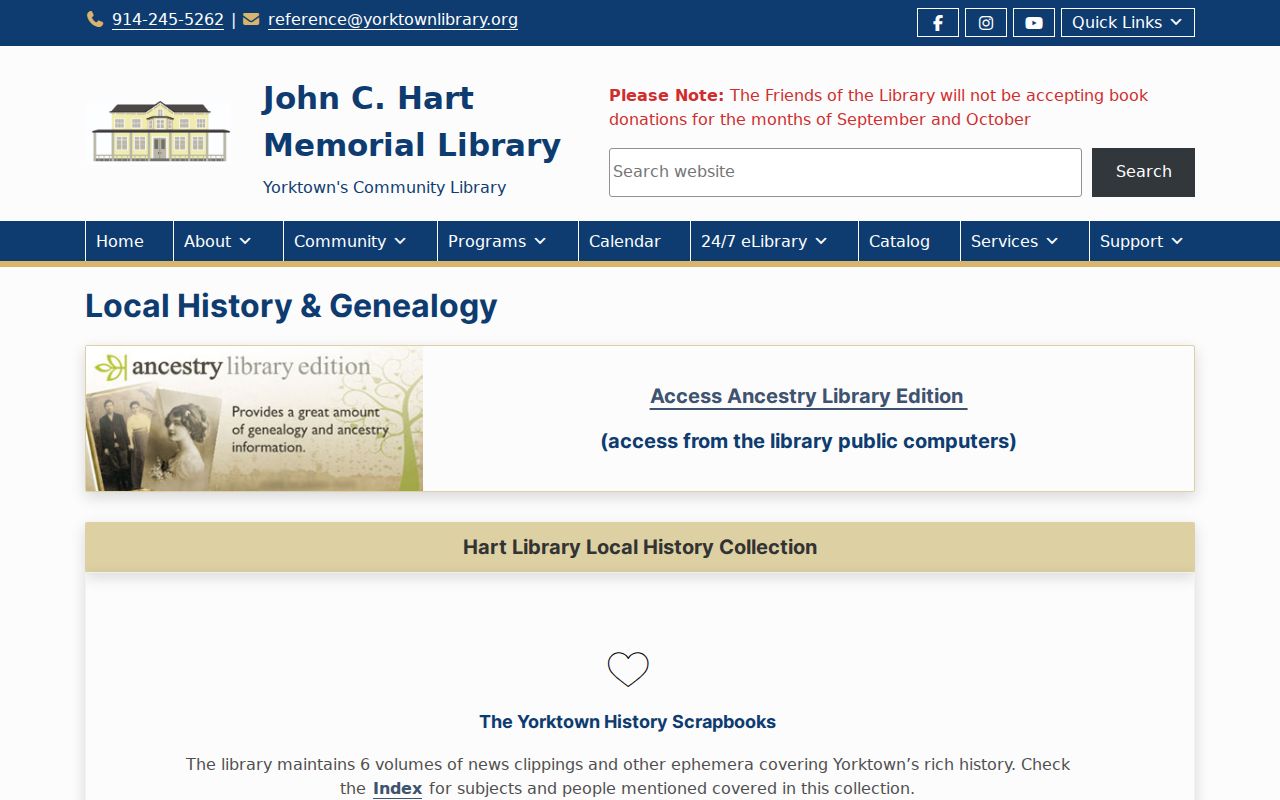
Hart’s Hyatt Local History Collection focuses on Shrub Oak and includes books, pamphlets, maps, photographs, indexes, and newspapers. The Yorktown Museum’s Auser Research Room adds genealogy, maps, and local-area historical records. Neither Yorktown institution claims a full former-resident directory, so preserve gaps and ask staff about a specific year, address, or hamlet.
- Use a dated obituary or scrapbook result to record the exact name variant and event date.
- Pair the era with a released federal census or eligible NYS vital index, which supplies a separate household or event check.
- Use a deed or estate file to test a property connection rather than assuming a family relationship.
- Ask Hart, the Museum, or the County Archives for the underlying item when the index or clipping leaves an address uncertain.
Yorktown Estate and Obituary Endpoints
A Yorktown obituary can identify a death and family context. For a Yorktown estate, probate can identify a fiduciary, heir, or attorney in a filed estate. A later deed may then show how title changed. Westchester Surrogate’s Court records from 2008 forward are searchable through WebSurrogate; some earlier material may require paper or microfilm at the court. Do not turn a probate contact into a current address claim, and do not treat a missing web case as a negative result.
The NYS Archives vital microfiche gives name, event date, event place, and certificate number for its documented historical runs. State registration did not have complete compliance until 1913 or later, so an early absence is not conclusive. Church, cemetery, newspaper, probate, and land evidence can be more useful for an older Yorktown household.
Note: Mark each claim by role, such as owner, grantor, grantee, named heir, or household member, instead of collapsing them into “resident.”
Yorktown Rolls and Permit Dates
Yorktown assessment rolls and property cards can place a property in a dated municipal record, but their scope remains assessment and property administration. Yorktown’s Assessor maintains ownership information, physical inventory, assessment rolls, exemptions, and transfer review. The Town links current and archived Yorktown rolls from its Assessor menu, although this research did not verify one complete archive span. Ask the Yorktown Assessor for the relevant roll date, property card, ownership or sale confirmation, and tax-map change information by SBL instead of assuming each historical detail appears online.
Yorktown Building, Highway, and Planning material can add dates for construction, certificates of occupancy, driveway or street-opening permits, subdivision work, and site plans. Yorktown’s current Building and Planning workflow uses Cloudpermit for applications and uploads, while historical address files may require a research request or FOIL. Applications filed on or after December 31, 2025 follow the 2025 New York building and energy code editions. That change can help date a permit record, but an applicant or project contact is not proof of a past household.
Limits on Yorktown Previous Residents
Some Yorktown gaps cannot be filled from public records. A title trail does not establish renters, adult household members, unrecorded moves, protected addresses, utility accounts, motor-vehicle data, or sealed court material. No official Yorktown Sanborn-map year run, Yorktown-wide renumbering order, or public permit-history start date was verified. Historical research works best when it reports the source, its era, and what it did not establish.
For current address-keyed work, use the Yorktown streets reference rather than extending an old title chain into a claim about current occupants. New York confidentiality rules also protect eligible Address Confidentiality Program participants, confidential voters, and restricted vital or court records.
Lawful use. Use Yorktown previous-resident research for house history, family history, estate questions, and personal curiosity. Do not use an address trail to track, stalk, harass, or harm a living person.